
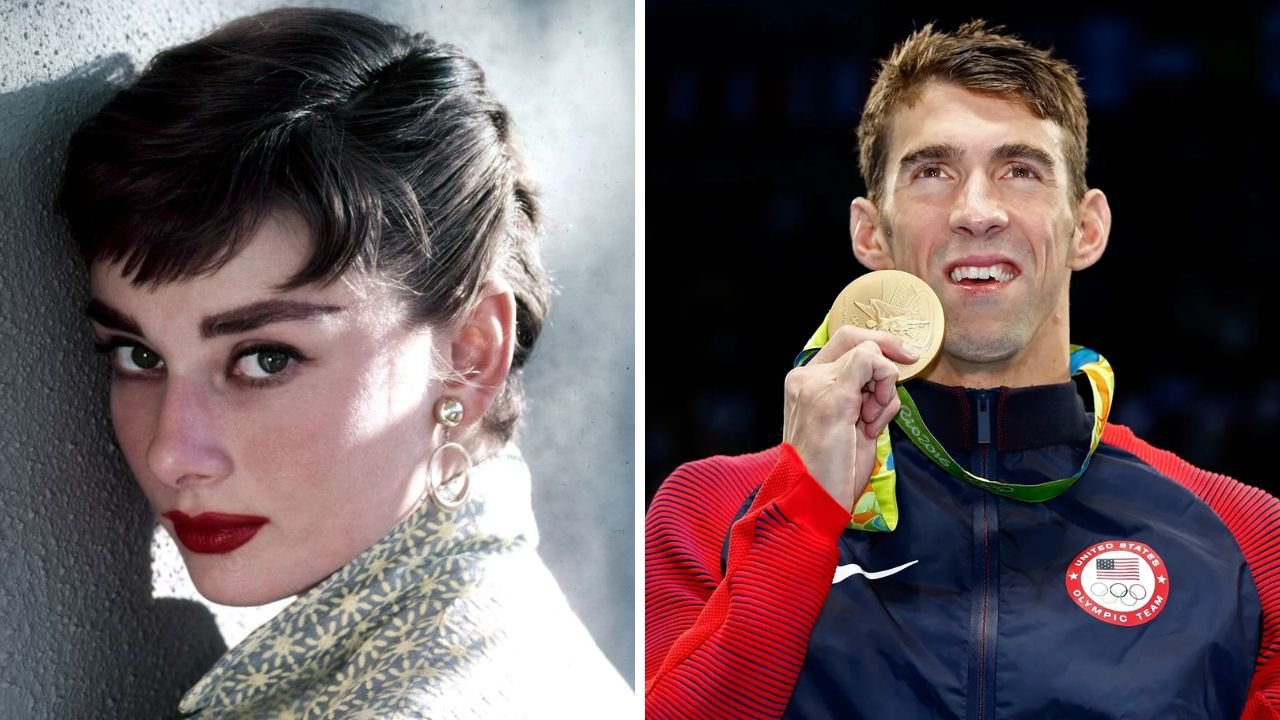
The names Audrey Hepburn and Michael Phelps belong to two completely different worlds. Hepburn became one of the most admired actresses of classic Hollywood, while Phelps became the most decorated Olympian in history through an extraordinary swimming career. One was celebrated for cinema, fashion, elegance, and humanitarian work, while the other became famous for discipline, speed, endurance, and record-breaking performances in the pool.
At first glance, there seems to be no obvious reason for these two names to appear together. They were born 56 years apart and followed very different professional paths. Hepburn was born in 1929 and died in 1993, while Phelps was born in 1985 and rose to international fame as a swimmer in the late 1990s and 2000s. There is no credible evidence that they were related, worked together, or had a significant personal relationship.
Still, Audrey Hepburn and Michael Phelps make an interesting comparison because both became international symbols of excellence. Their stories show how talent, discipline, perseverance, and public influence can create a legacy that lasts far beyond a person’s original career.
Audrey Hepburn: A Hollywood Legend
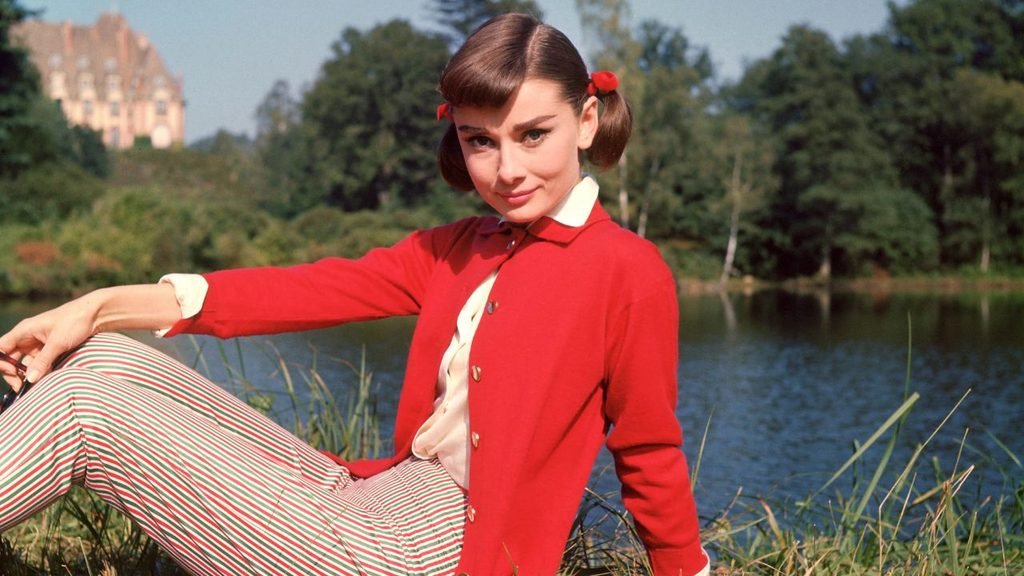
Audrey Kathleen Hepburn was born on May 4, 1929, in Brussels, Belgium. She spent parts of her childhood in England and the Netherlands, and her early years were shaped by the difficult circumstances of World War II.
Hepburn eventually moved into entertainment and developed a career that made her one of the defining actresses of her generation. Her delicate screen presence, graceful personality, and ability to bring emotional depth to her characters helped separate her from many other stars of the era.
Her breakthrough came with Roman Holiday, the 1953 romantic comedy in which she played Princess Ann opposite Gregory Peck. The performance brought her an Academy Award for Best Actress and established her as a major Hollywood star.
She later appeared in celebrated films including Sabrina, War and Peace, Funny Face, Breakfast at Tiffany’s, Charade, My Fair Lady, and Wait Until Dark. These performances helped make her a lasting figure in film history.
Audrey Hepburn’s Influence Beyond Film
Hepburn’s influence was never limited to acting. She became one of the most recognizable fashion figures of the twentieth century, with her simple and elegant style continuing to influence fashion decades after her death.
Her image became closely associated with sophistication, but her later humanitarian work revealed another important side of her personality.
During the later part of her life, Hepburn became a Goodwill Ambassador for UNICEF. She traveled to countries affected by poverty, hunger, disease, and conflict, using her fame to draw attention to the needs of vulnerable children.
This humanitarian work became a major part of her legacy. Today, Hepburn is remembered not only as a movie star but also as someone who used her public platform to advocate for children around the world.
Michael Phelps: The Swimming Phenomenon
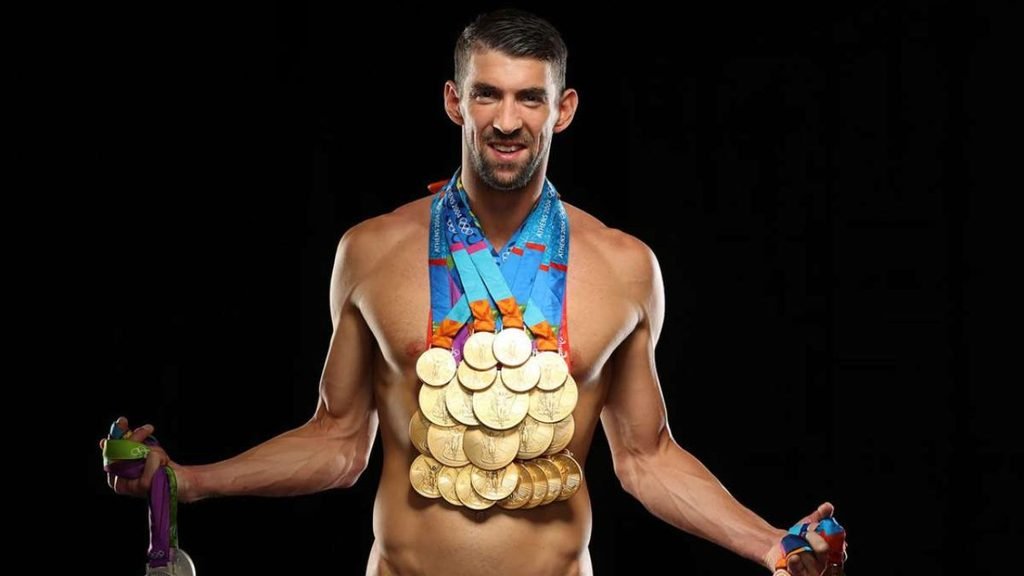
Michael Fred Phelps II was born on June 30, 1985, in Baltimore, Maryland. Unlike Hepburn, whose success developed through acting and entertainment, Phelps found his path in competitive swimming.
He began swimming at a young age and eventually developed into one of the greatest athletes in Olympic history. His combination of physical ability, technical skill, training discipline, and competitive focus allowed him to dominate international swimming for many years.
Phelps first competed at the Olympics at the age of 15 during the 2000 Sydney Games. Although he did not win a medal at those Games, his Olympic journey had only just begun.
At subsequent Olympics, his medal collection grew dramatically. He became particularly dominant at the 2004 Athens Olympics, the 2008 Beijing Olympics, the 2012 London Olympics, and the 2016 Rio de Janeiro Olympics.
According to Team USA, Phelps finished his Olympic career with 28 medals, including 23 gold medals, making him the most decorated Olympian of all time.
Why Michael Phelps Became an Olympic Icon
Phelps’ achievements were remarkable because they were not the result of one successful competition. They came from years of intense preparation and repeated performances at the highest level.
His eight gold medals at the 2008 Beijing Olympics became one of the most memorable achievements in Olympic history. That performance demonstrated his ability to compete under enormous pressure while maintaining an exceptional level of consistency.
His success also helped increase worldwide attention toward swimming. For many young athletes, Phelps became an example of what could happen when natural ability was combined with years of focused training.
His legacy therefore extends beyond the medals themselves. He became a symbol of athletic ambition and long-term commitment.
Audrey Hepburn and Michael Phelps: Is There a Connection?
One of the most important points about Audrey Hepburn and Michael Phelps is that there is no documented evidence of a meaningful personal, family, or professional relationship between them.
Hepburn died in January 1993, when Phelps was only eight years old. Phelps later became internationally famous through competitive swimming, particularly during the 2000s.
There is also no established evidence of a joint movie, charity project, interview, friendship, or professional collaboration involving the two.
Therefore, readers should not interpret the search phrase Audrey Hepburn and Michael Phelps as evidence that they knew each other.
The more accurate way to understand the comparison is to examine what their individual lives have in common.
Two Different Careers With Similar Levels of Influence
Hepburn and Phelps achieved success through completely different professions, yet both became internationally recognizable.
Hepburn’s achievements were based on acting, storytelling, cultural influence, fashion, and humanitarian service. Phelps’ achievements were based on athletic performance, Olympic competition, records, and years of training.
Their success also shows two different ways that people can become icons.
Hepburn became famous through the emotional and cultural power of cinema. Her performances continue to be discussed and watched by new generations.
Phelps became famous through measurable sporting achievement. His Olympic medals and records provided clear evidence of his extraordinary competitive career.
In both cases, however, their influence eventually extended beyond their original professions.
Their Shared Commitment to Helping Others
Another interesting similarity between Audrey Hepburn and Michael Phelps is that both have been associated with efforts beyond their primary careers.
Hepburn’s humanitarian work with UNICEF became an important part of her later life. She used her international reputation to highlight the challenges faced by children living in difficult circumstances.
Phelps has also used his public platform for causes connected with health, youth, sports, and athlete well-being. His experiences as a highly successful athlete have contributed to broader conversations about the pressures faced by competitors.
Their approaches were different, but both demonstrated that public recognition can be used for purposes beyond personal fame.
The Importance of Discipline in Their Stories
Discipline is another useful way to compare Audrey Hepburn and Michael Phelps.
For Phelps, discipline was central to his daily life as an elite athlete. Swimming at the Olympic level required years of training, preparation, repetition, and mental strength.
Hepburn’s career required a different type of discipline. Acting demanded preparation, emotional control, learning dialogue, understanding characters, and adapting to demanding productions.
Neither career was simply about natural talent. Both required persistence and the ability to perform consistently in highly competitive environments.
Their stories demonstrate that long-term success usually involves much more than talent alone.
Audrey Hepburn’s Lasting Legacy
Audrey Hepburn died on January 20, 1993, at the age of 63. Even after her death, her influence continued to grow.
Her movies remain popular, her fashion style continues to inspire designers and audiences, and her humanitarian work remains an important part of her biography.
Few actresses have maintained such a strong cultural presence decades after their careers ended. Hepburn’s image has become almost timeless, but her legacy is about more than appearance.
Her contribution to humanitarian causes helped create a deeper understanding of her public life. She showed that a famous person could use international recognition to bring attention to people who had little public voice.
Michael Phelps’ Legacy After Competition
Phelps retired from competitive swimming after the 2016 Rio Olympics. By that point, his Olympic achievements had already placed him among the most successful athletes in sports history.
His post-competition life has involved public speaking, charitable activities, family life, and advocacy surrounding issues important to athletes and young people.
His story also illustrates the challenges that can come after an athlete leaves elite competition. Moving from a highly structured sporting environment into ordinary life can require significant adjustment.
For Phelps, his public identity gradually expanded from being an Olympic champion to becoming an advocate and public figure with interests beyond swimming.
Audrey Hepburn and Michael Phelps: What Can We Learn From Them?
Although Audrey Hepburn and Michael Phelps never shared a documented professional relationship, their biographies provide several valuable lessons.
First, extraordinary success can come from very different talents. Hepburn found her path through acting and humanitarian work, while Phelps found his through swimming.
Second, international fame does not necessarily come from the same kind of achievement. Hepburn’s influence was cultural and artistic, while Phelps’ was athletic and competitive.
Third, a person’s legacy can become much larger than their original profession. Hepburn became more than an actress, and Phelps became more than a swimmer.
Finally, both stories show the importance of using influence responsibly. Their public careers demonstrate how people can affect others long after their biggest professional achievements are finished.
Quick Biography Table
| Detail | Audrey Hepburn | Michael Phelps |
|---|---|---|
| Full Name | Audrey Kathleen Hepburn | Michael Fred Phelps II |
| Born | May 4, 1929 | June 30, 1985 |
| Birthplace | Brussels, Belgium | Baltimore, Maryland, USA |
| Main Profession | Actress and humanitarian | Competitive swimmer |
| Famous For | Classic Hollywood films | Olympic swimming |
| Major Achievement | Academy Award-winning acting career | 28 Olympic medals |
| Olympic Gold Medals | Not applicable | 23 |
| Humanitarian Work | UNICEF | Youth, health, sports and athlete advocacy |
| Career Era | Mainly 1950s–1980s | Mainly 2000s–2010s |
| Death | January 20, 1993 | Living as of 2026 |
Frequently Asked Questions
Are Audrey Hepburn and Michael Phelps related?
No. There is no credible evidence of a family relationship between Audrey Hepburn and Michael Phelps. Their biographies come from different family backgrounds and generations.
Did Audrey Hepburn and Michael Phelps ever meet?
There is no reliable public record establishing a significant meeting between them. Hepburn died in 1993, when Phelps was only eight years old.
Did Audrey Hepburn influence Michael Phelps?
There is no well-documented evidence showing that Hepburn directly influenced Phelps. Claims about a direct connection should not be treated as fact without reliable evidence.
What was Audrey Hepburn famous for?
Hepburn was famous for her acclaimed acting career, including films such as Roman Holiday and Breakfast at Tiffany’s. She was also a major fashion icon and later became known for her humanitarian work with UNICEF.
What was Michael Phelps famous for?
Michael Phelps became famous for his extraordinary competitive swimming career. He won 28 Olympic medals, including 23 gold medals, making him the most decorated Olympian in history.
Why are Audrey Hepburn and Michael Phelps mentioned together?
The names are best understood as a comparison between two globally recognized people who achieved exceptional success in completely different fields. There is no established personal relationship between them.
Final Thoughts
The story of Audrey Hepburn and Michael Phelps is ultimately not about a hidden relationship between two famous people. Instead, it is a fascinating comparison between two individuals who reached the highest levels of recognition in very different ways.
Audrey Hepburn created a lasting legacy through film, fashion, grace, and humanitarian service. Michael Phelps created his legacy through extraordinary Olympic performances, discipline, and years of elite swimming.
Their lives belonged to different generations, and there is no credible evidence that they were related, worked together, or shared a significant personal connection. Yet both remain powerful examples of how exceptional achievement can influence generations.
Hepburn demonstrated the cultural power of cinema and compassion. Phelps demonstrated the power of athletic dedication and competitive excellence. Together, their stories remind us that greatness does not have one definition—and that a lasting legacy can come from many different paths.
Read More: Selena Gomez and Jeff Greene: Biography, Careers, and Facts

Hi, I’m Alex Morgan, a passionate writer at The Quick Magazine. I cover biographies, business, lifestyle, news, and trending stories, with a focus on creating clear, engaging, and well-researched content for readers.
